
 Service Hotline:+86-13816217984 Service Hotline:+86-13816217984



— Product —
 Service Hotline +86-13816217984
 Email:info@standard-groups.com
Landline:+86(21)-64208466
Telephone:+86-13816217984
Address:Unit 3A, 20/F,Far East Consortium Building,121 Des Voeux Road Central, Hong Kong
Flame-retardant building materials

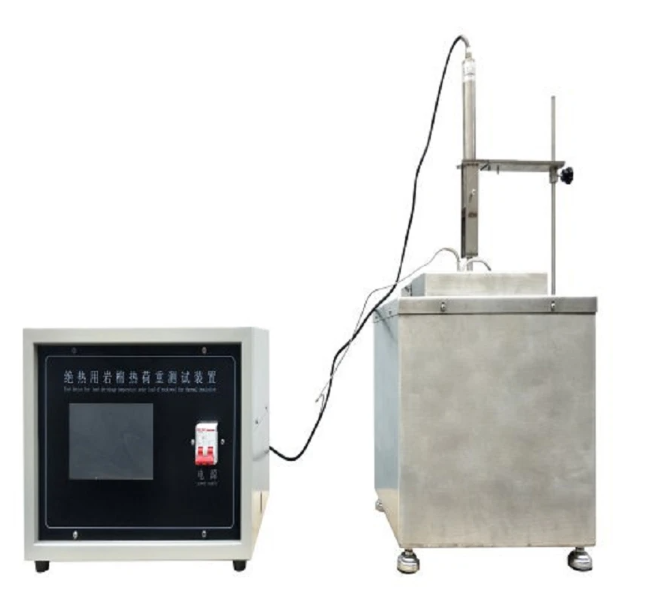
This device tests the thermal load shrinkage temperature of rock wool insulation used for heat insulation under a specific load and heating rate, complying with standards like GB/T11835....
 Enquire NowEnquire Now
Phone Number :+86-13816217984
WhatsApp:+86-13816217984Email:info@standard-groups.comProducts
This equipment determines the temperature at which rock wool insulation shrinks under a specified load when heated at a controlled rate, crucial for assessing its performance in thermal insulation applications.
1. Seven-inch full-color touch screen control, multi-point program heating,
2. Ambient temperature: room temperature ——40℃ Relative humidity :≤75%
3. Working voltage: AC 220V±10V 50HZ
4.Total power :2.5KW Heating power :1000W
5. Scale measuring range: room temperature ——900°C
6. Heating rate: Room temperature ——400℃,5°C/min, 400——800℃, 3℃℃/min
7. The instrument adopts single-chip computer and multi-point program heating
8. Fixture: stainless steel material; anti-corrosion
9. The heat source of the instrument is hot plate
10. Sample :490pa pressure
11. Test barrel :48mm±1mm
12. Equipment weight :50 Kg
Industrial Insulation: Verifying the high-temperature resistance of rock wool insulation layers in equipment such as pipes, storage tanks, and boilers to ensure structural stability, reduce heat loss, and meet safety standards.
Building Energy Efficiency: Evaluating the thermal stability and fire resistance of rock wool insulation materials for exterior walls and roofs, preventing deformation or cracking at high temperatures, and improving building energy efficiency and safety.
Marine Fire Protection: Testing the shrinkage resistance and thermal insulation capabilities of marine rock wool insulation materials under high-temperature fire conditions to ensure the safety of ship structures.
Energy Engineering: Selecting rock wool materials for high-temperature equipment in nuclear power and thermal power plants, verifying their long-term temperature resistance to ensure the safe operation of energy systems.
Scientific Research and Quality Inspection: Supporting the development of new materials and the establishment of standards, providing accurate thermal load data, and promoting technological upgrades in the rock wool industry.
GB/T11835-2007: Thermal insulation rock wool, slag wool and its products
ISO1716-2002 : Reaction of building products to flame test Determination of heat of combustion
1. Place the support block in the center of the furnace, then place the sample tube containing the sample on the support block (sample size defaults to 80mm). Insert the pressure rod into the top of the sample tube. Note that the pressure rod should be allowed to fall naturally without applying any force.
2. Install the displacement sensor above the pressure rod, passing the pressure rod through the circular hole on the sensor housing. Adjust the sensor so that the displacement meter displays a value between 10 and 15; then tighten the sensor beam screws.
3. After adjusting the sensor, press "Start" on the control panel. The experiment begins, and the "Start" button turns green.
4. When the pressure rod's downward displacement reaches the set value, the experiment ends, the "Stop" light illuminates, and the experiment is complete.
5. After the experiment, press the "Save" button. A storage interface will appear. Click the box next to the experiment name to bring up the keyboard interface to edit the name you want to save. Press the OK button to return to the storage interface and click "Save Data". The data can be viewed in the historical data interface after saving.
6. If there are any problems during the experiment, you can also press "Stop" to cancel the experiment.
Related Products
Service Hotline


